Names changed to protect the innocent — mostly because he’d never let me live down “the tower that fell for love of an oak tree.”
It started with the flu.
January 2025. A nor’easter was building offshore — the kind that doesn’t ask permission before it arrives. Forecasters were calling for gusts to 50 miles an hour across South Jersey, and every tower owner within a hundred miles was running the same mental checklist: how loaded is the mast, when did I last check the hardware, when did I last check the base.
A friend of mine — I’ll call him J — was flat on his back with the flu that night. Fever and all. His TX-472, cranked up to 72 feet with another 20 feet of mast above that and thousands of dollars of HF, VHF/UHF, and microwave antennas riding on top, was going to stay up. Cranking it down in his condition wasn’t safe, and he knew it. So he made the call, and hoped the hardware held.
It didn’t.
One of the anchor bolts — the bolts that pin the base plate to the concrete foundation — let go. Ninety-two feet of tower went over.
I want to be careful here, because it’s easy to read that paragraph as “J did something reckless.” He didn’t. He’s been a ham a long time. He knows his equipment cold. The decision he made that night was a calculated risk in a genuinely bad spot — when you’re running 103 degrees and the wind is howling, “go outside and crank down the tower” is not the obvious right answer. Sometimes the hardware fails. That’s not a character flaw. That’s physics having a bad night.
What matters is what happened next.
The tower went over and — this is the part that still makes me shake my head — it landed in the V of a big oak tree. Just settled in there, like it was always meant to. The tree caught it. Nothing hit the ground, a fence, a house, a neighbor. The antennas took a beating and the tower was done for the season, but J could stand there and count his blessings before he started counting the damage.
Fast forward three months. Late April.
J had done his homework, made some calls, and rounded up help. The day before the crane arrived, a tree crew showed up — the backyard was ringed with mature trees, and a 40-ton National Crane NBT-45 was going to need a flight path. They spent the day trimming, carefully, opening just enough of a corridor to fly 92 feet of tower and antenna array through without turning it into a very expensive game of pinball. That work doesn’t show up in the photos. It absolutely shows up in the outcome.
Then the rigger showed up — I’ll call him K — the kind of ham who’s forgotten more about towers than most of us will ever know. J had him on site from the first lift to the last bolt.
I showed up with a camera and whatever two extra hands are worth when the people who actually know what they’re doing are working.
The plan: rent the crane, get the tower off the tree, lay it down safely, figure out the rest from there.
Getting a 40-ton crane into a residential backyard is its own adventure — not something you thread through a gate without serious spotting, and we still needed room for the outriggers and the man basket. The operator was a big, burly guy, built like he’d spent a career hauling steel, with a short fat cigar clamped in his teeth and going the whole time — at nine in the morning, mind you. He didn’t say much. He didn’t need to. Once he was set, the boom went up and we got to work.
The first thing that became clear: standing the tower back upright wasn’t happening. The anchor bolts were already bent and compromised — you don’t trust a 92-foot loaded crank-up to hardware that’s already shown you exactly what it does when it lets go. So the call got made. Cut it free from the base. Fly it over the trees. Lay it down on the grass.
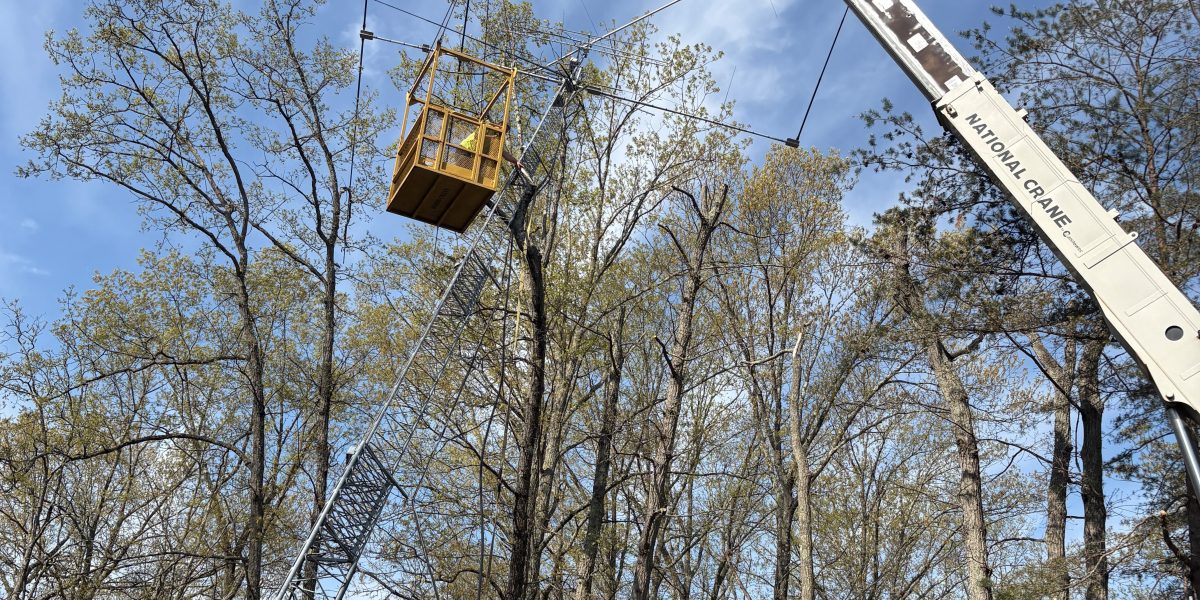
K rigged the tower with two chokers — wire rope slings distributing the load — and ran a tag line down to the ground crew so we could control the swing as the crane lifted. That’s how you move something like this without it turning into a pendulum and taking out a fence line, or a neighbor’s garage.
The crane picked it up. And then — slowly, carefully, with K working the rigging from the man basket near the top — it flew.
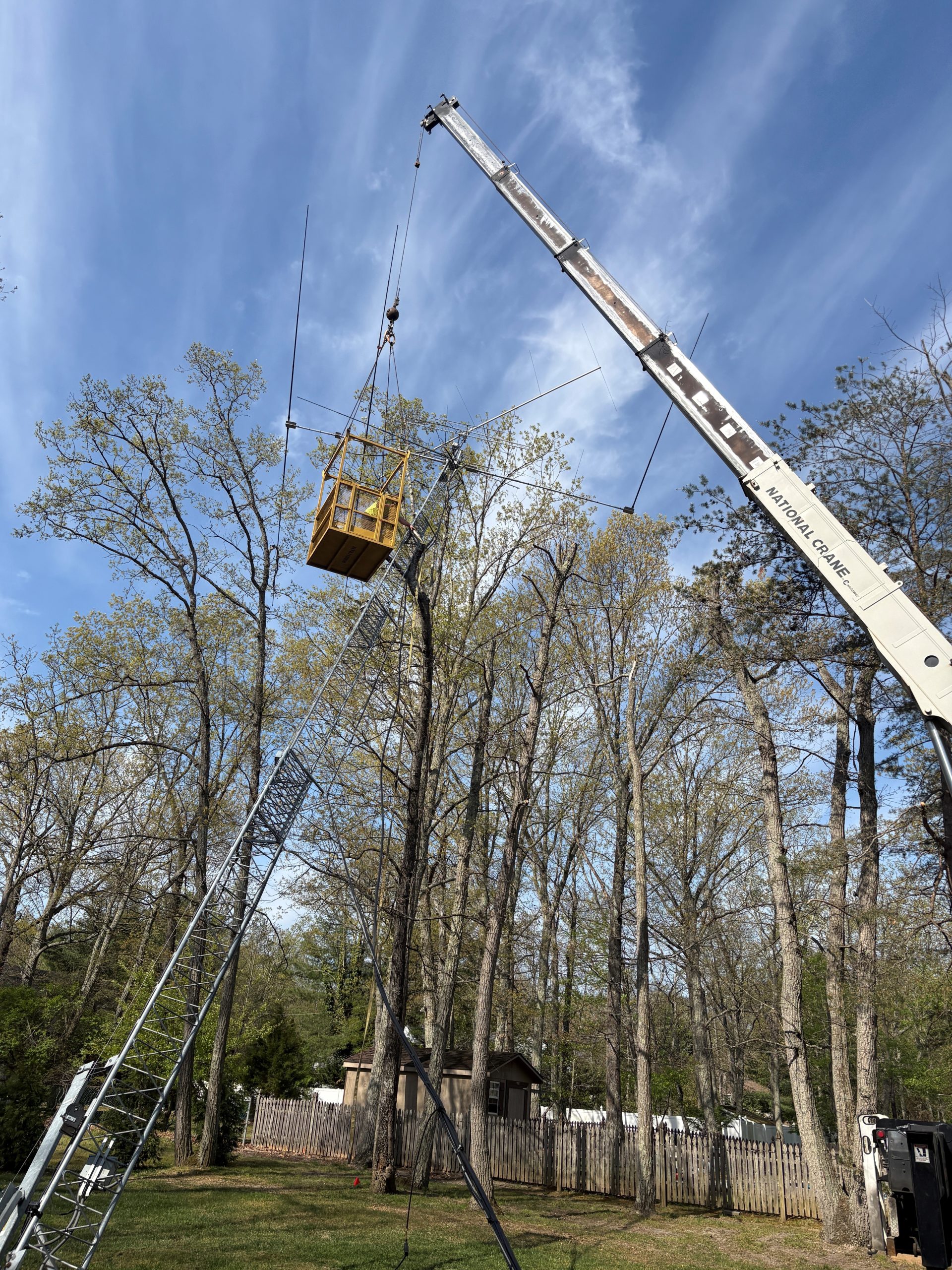
I’ll be honest: I wasn’t completely sure how this was going to end until it was over. The yard was tight. Even with a day of tree prep behind us, the canopy was tall and the tower was 92 feet long with a full array riding on top. We had to rotate mid-flight to walk the antennas through gaps in the trees. The SteppIR’s tilt mechanism — the one that lets the driven element fold back — was the only reason it came out the other side intact. Even then, it was close.
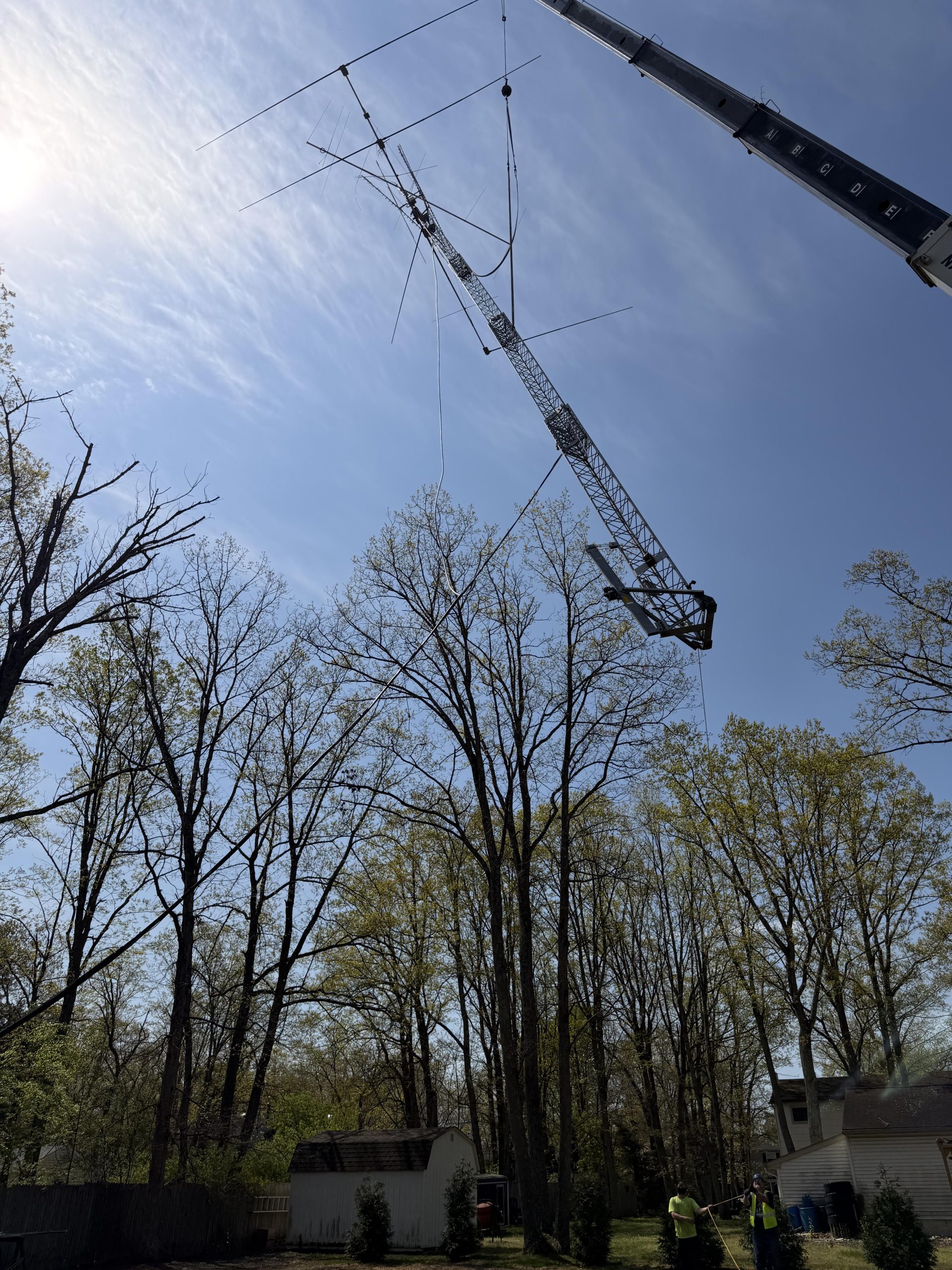
But it worked. All 92 feet of it, laid out on the lawn, in one piece. The antennas were bent and battered on the grass beside it — but recoverable. SteppIRs are tough.
Everyone took a breath. Then we started figuring out what could be saved.
Here’s where it got slow.
J filed the claim, and the insurance company did what insurance companies do — a lot of wiggling before anything got approved. Eventually they agreed to cover the tower, the antennas, and the mast in full. Which was generous, because as far as anyone could actually tell, only the antennas and the mast were damaged. The tower itself — the steel that had just ridden a 92-foot fall into a tree fork and back out again — was an unknown quantity. No cracks anyone could see, nothing obviously bent. But “nothing obviously wrong” isn’t the same as “sound,” and putting an unknown tower back up in your own yard is its own kind of risk. J decided that wasn’t a risk he wanted to take.
But J didn’t know that for certain. Ninety-two feet of galvanized steel had just taken an unscheduled trip through a hardwood, and nobody could swear to its structural state with total confidence. Rather than put an unknown quantity back up in his own yard, he made the call to sell it — to me — and order a new one instead.
That should have been simple. It wasn’t. The insurance payout took months to actually land, because it had to clear before J could place the order for a replacement. Six months, start to finish, before the money showed up and the deal could close. Same tower, same model, considerably more expensive than the one that fell.
So: a tower that went over in a January storm, got caught by an oak, got flown out of a tree by a 40-ton crane in April, and finally became mine sometime around October — six months after the crane operator packed up and drove away.
It had been sitting, patient and enormous, the whole time.
What Tower Owners Should Know
I’ll say this plainly: J made reasonable choices in a genuinely difficult situation, and the outcome — expensive and stressful as it was — wasn’t catastrophic. Nobody got hurt. The tree caught what gravity took. But the whole episode is worth learning from, so here’s what stuck with me.
Your anchor bolts are a maintenance item, not a permanent fixture. They look permanent because they’re set in concrete. They’re not. Embedded steel corrodes — sometimes invisibly — and fatigues over time, especially on a crank-up that sees regular load cycles and wind stress at the base plate. If you don’t know when yours were last inspected, that’s your answer. Pull the nuts, check for corrosion and cracking, replace on a schedule.
A crank-down strategy only works if you can actually execute it. J’s TX-472 has a crank-down mechanism, which is exactly the right kind of tower to own in storm country. But being able to crank down means being physically capable of doing it, safely, on the night it matters. Think now about who else could do it if you couldn’t. A trusted neighbor with a quick orientation and a key to the gate might be the difference between a close call and a real disaster.
When things go wrong, don’t improvise the rigging. This operation went smoothly because K had the knowledge to do it right — two chokers, tag line control, proper lift points. A crane by itself doesn’t make a recovery safe. The rigging knowledge does. Find your K before you need him.
Tree prep is part of the job. The crew that opened the canopy the day before anyone else showed up made the whole lift possible. If your tower ever has to come out of a tight yard, that step can’t be an afterthought — it’s the first one.
There’s a version of this story where J doesn’t get lucky with that oak. Where the tower comes down across a fence, or through a neighbor’s roof, or — I don’t love thinking about this one — where he tries to crank it down sick, in the dark, in the wind, and something goes wrong out there alone.
None of that happened. Instead, a big oak did what oaks do, held its ground, and bought everyone enough time to come back in April with a crane and some good people. Six months after that, a tower that had already lived through a January storm, a tree, and an insurance department’s idea of urgency ended up parked in my yard.
It’s still there. Still in pieces. Still enormous.
Getting it wasn’t the last piece of work, though. It still had to get from J’s yard to mine.
My first plan was simple, at least on paper: rent a tilt-and-roll flatbed tow truck, back it into the yard, tilt the bed down, winch the tower up onto it, drive it home. Clean. Boring. The kind of plan that works fine right up until you’re standing in a yard looking at 92 feet of tower sections and realizing “simple” and “this” don’t belong in the same sentence.
So before committing to anything, I called my cousin Mike — the closest thing our family has to a MacGyver — to get a second opinion. He had a better idea, and it involved a piece of equipment I hadn’t even considered: a Moffett. If you’ve ever seen a forklift riding piggyback on the back of a Home Depot delivery truck, that’s a Moffett — a self-loading forklift that can climb up onto its own truck bed and then drive itself around a job site once it’s there. Mike had one. He brought it over.
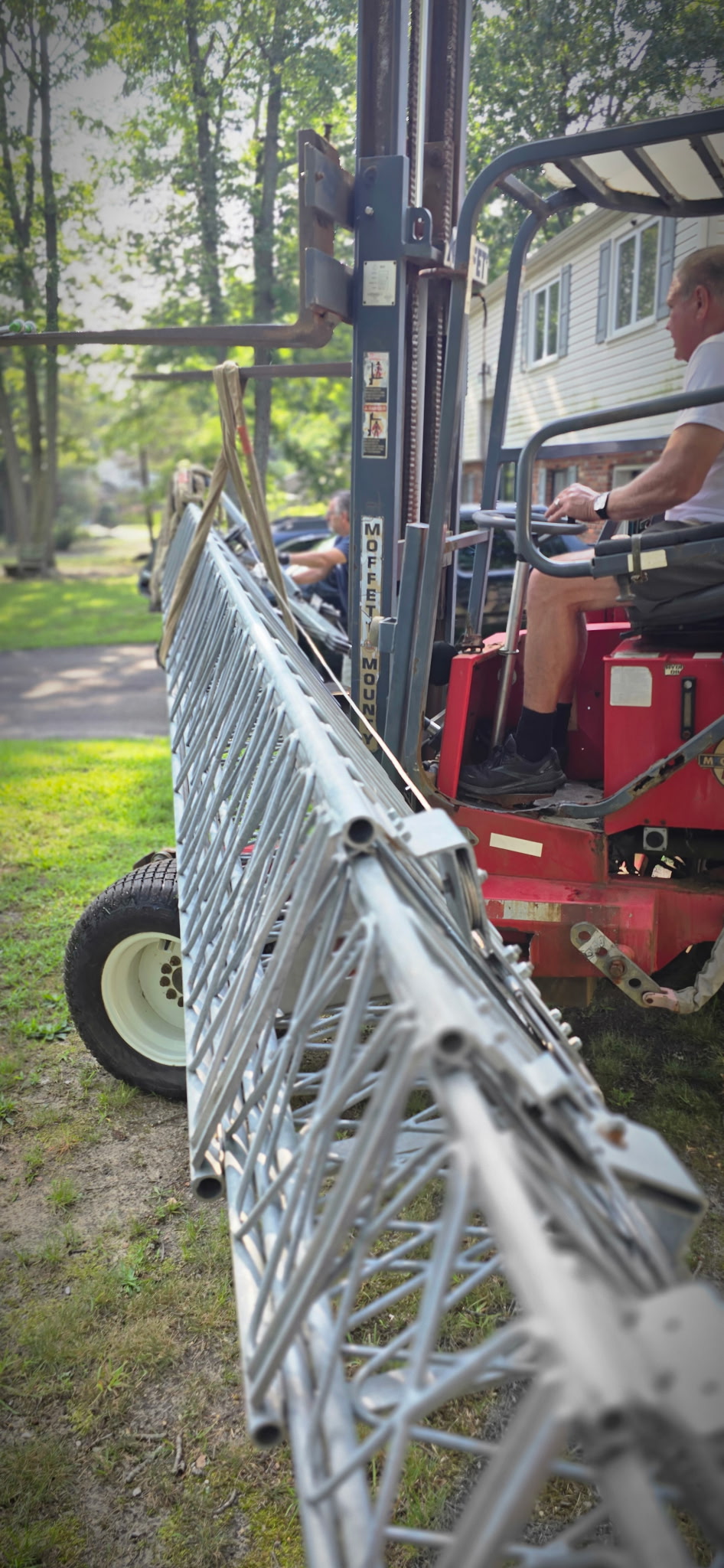
The plan changed on the spot.
We threw a choker around the tower, worked out where the center of gravity actually was, and then — almost anticlimactically — just walked it out of the backyard. Two men on each end, steering it left and right as it moved, threading it through the trees. Angle it thin to slide between trunks, then swing it wide again once we had clearance. It went smoothly enough that it almost felt too easy after everything it took to get this tower out of a tree in the first place.
Once it was clear of the yard, we loaded it onto the trailer and strapped it down — carefully, watching for the limit switches, the winch, and the crank mechanism the whole time. That’s not hardware you want to compress under a ratchet strap without thinking about it first.
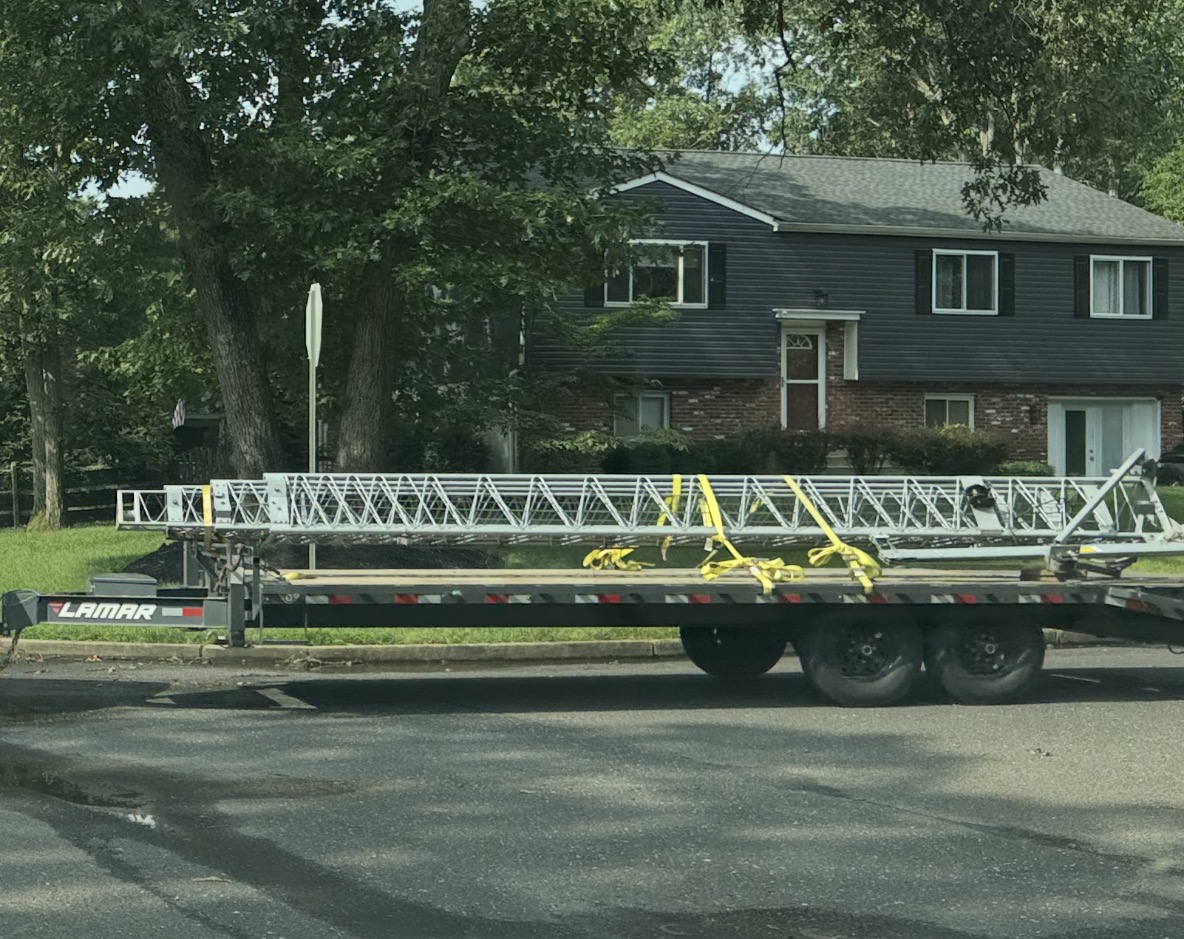
Fifteen miles later, we were at my QTH.
Which is when the problem I hadn’t thought through caught up with me: the Moffett — the only thing that had made loading it this easy — was still back at Mike’s, sitting in the yard we’d just left. It could put the tower on a trailer. It could not, at this particular moment, take it off one.
Except that wasn’t actually a problem. Not at my place.
I live on fifty acres, and one of the advantages of a working farm is that you end up owning, or at least having access to, most of the equipment you’d ever need for a job like this. In this case, that meant my JCB 85Z-2 — an 8-tonne compact excavator that earns its keep around here, and the same machine I’d already used to stand my Rohn TXDBX-48 upright. Same idea as the Moffett, different tool. Same program, too: choke up the tower at its center, find the balance point, and lift.
We picked it clean off the trailer, swung it over, and set it down on a stack of 4x4s to keep it off the ground while we figured out the next move.
And the next move wasn’t really about equipment anymore. It was a question: where does this thing actually go? I already had a tower running — the Rohn TXDBX-48, carrying a rotatable 40m dipole, a hexbeam, and a 2m vertical — and I had a much smaller EME tower going up as well. Now the TX-472 needed a home too, and I had a piece of ground that needed to make sense for all three towers at once.
That question — and the actual raising of it — is Part 2.
73 de N2LQH · Terry Rossi · South Jersey