There’s a particular kind of quiet that happens when a dozen people are all straining to hear a signal that isn’t there anymore.
That’s the whole game at the Pack Rats’ Minimum Discernible Signal test — MDS, if you’re in the club — and on Saturday, July 25th, I spent the morning on a grassy hillside in South Jersey watching some of the best microwave operators around chase a signal down into the noise floor, one decibel at a time. I wasn’t running anything myself. I was there to watch, learn, and — as it turned out — get thoroughly talked into a new rabbit hole.
The Setup
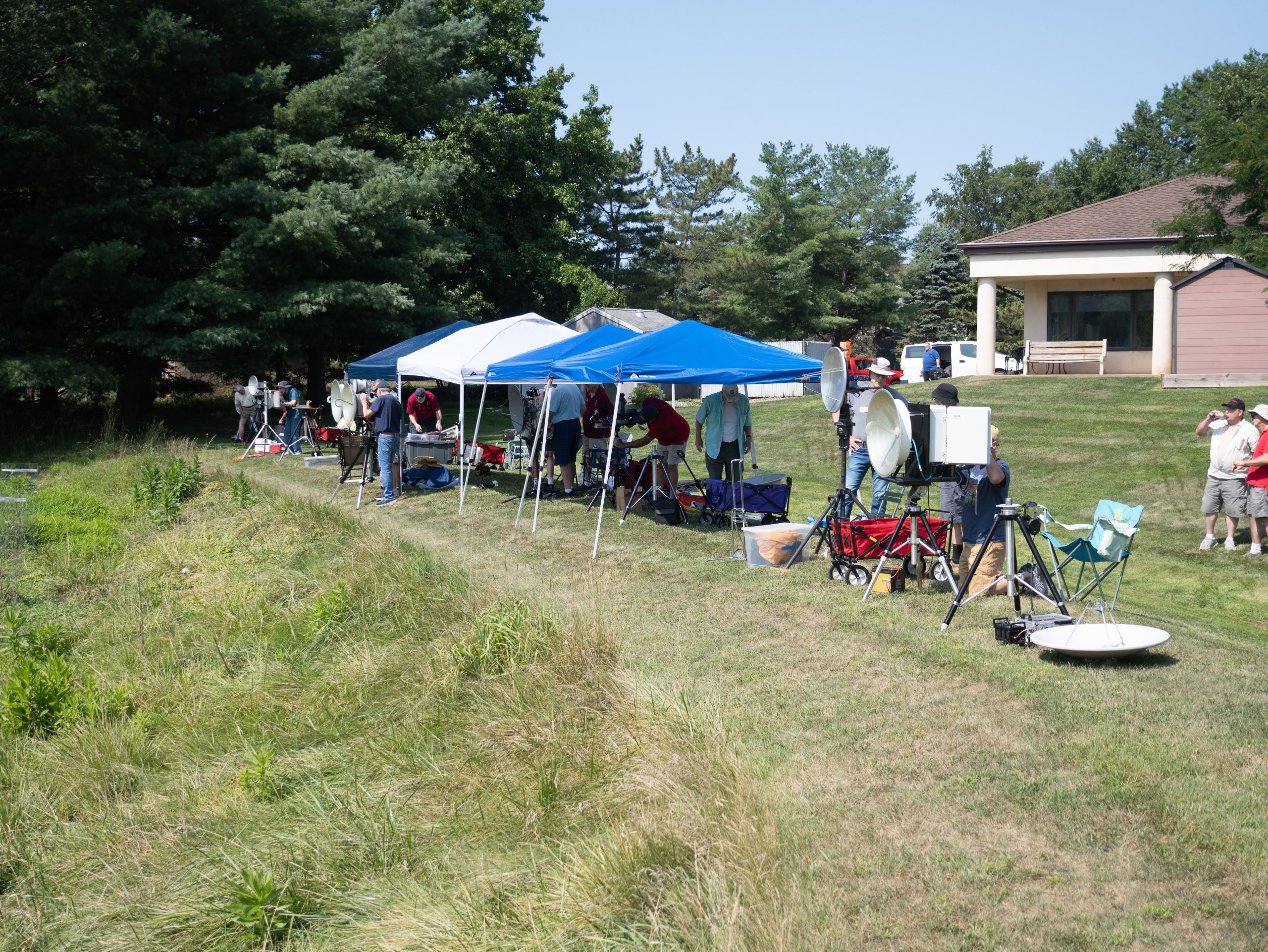
The premise is stupidly simple and brutally hard at the same time. A beacon sits about three to four hundred feet down the hill. Everybody lines up along the top with their dishes, converters, LNAs, and — for the ambitious — amplifiers, all pointed at the same spot. Every round, the beacon operator turns the power down by a decibel or more. Round after round, the signal gets quieter, until it isn’t really a signal anymore so much as a suggestion of one buried in the hiss. Whoever can still pull it out of the noise the longest wins. There’s no bandwidth to hide in and no antenna gain that fully makes up for a bad front end — at that point you’re not fighting propagation, you’re fighting your own receiver.
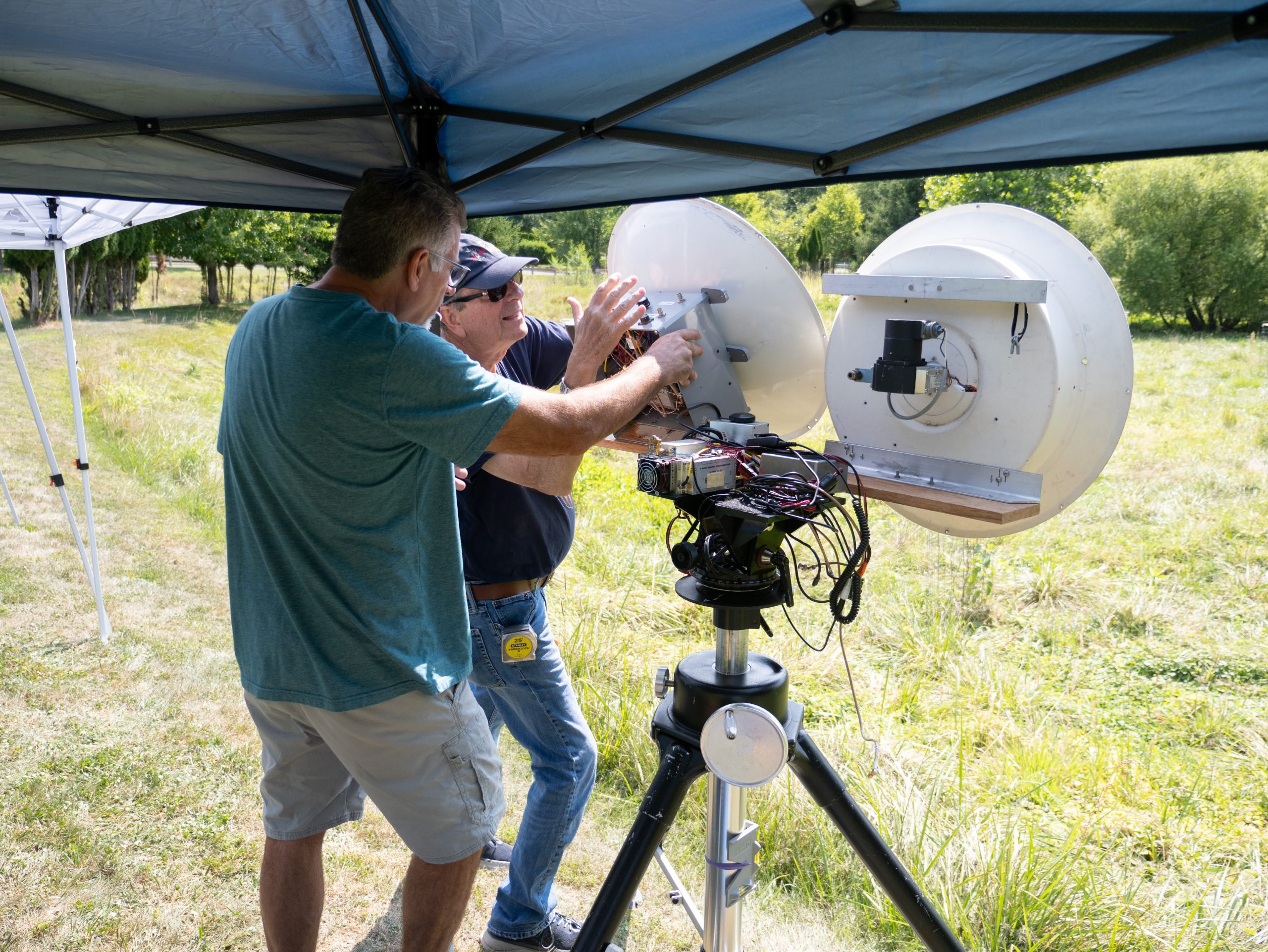
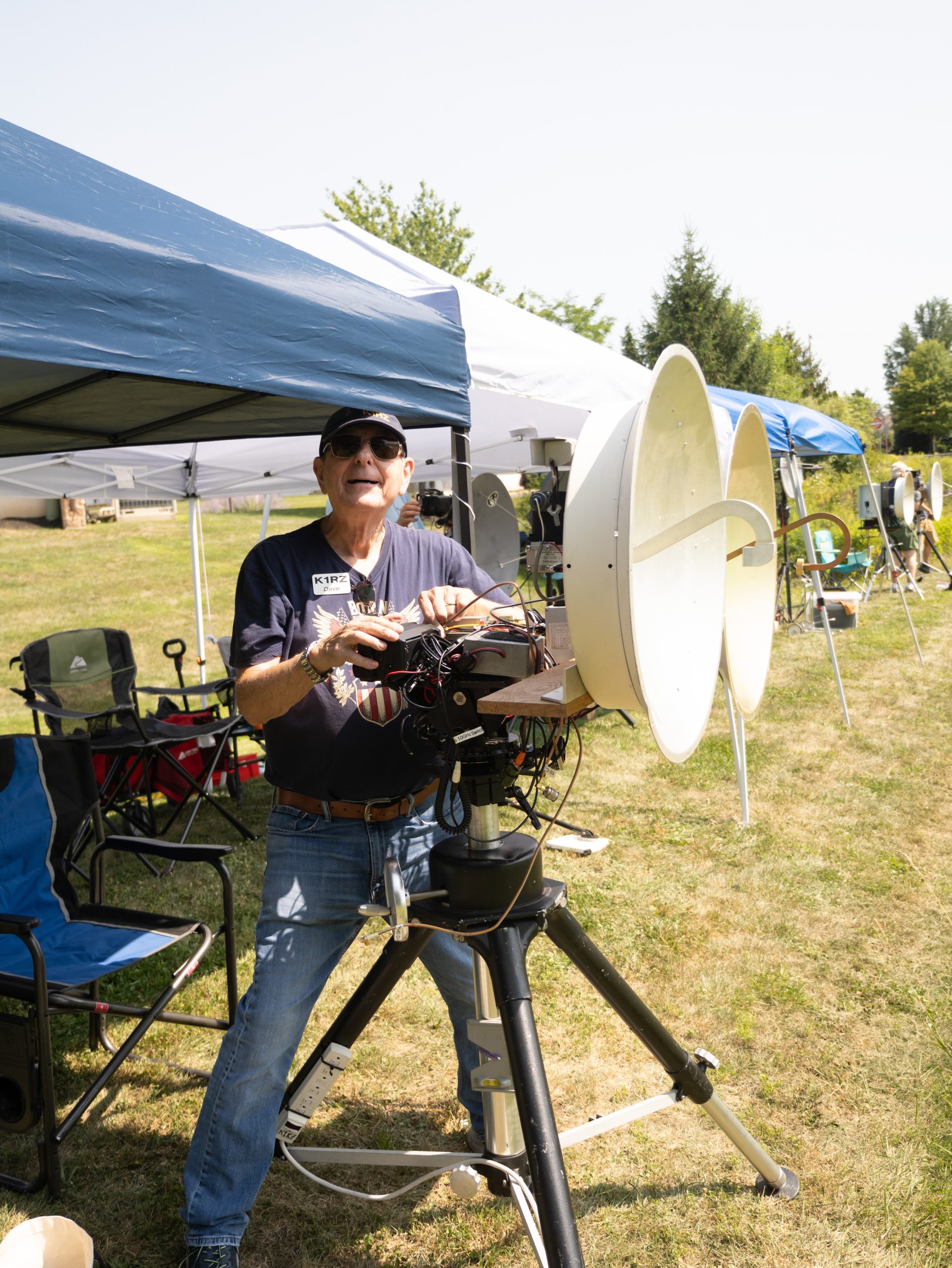
I got there early enough to help Dave, K1RZ, get his 10 and 24 GHz dishes set up before things kicked off — mounting hardware, cable dress, the usual pre-contest scramble. Dave’s a regular at the top of the results sheet, and watching him get his stations trimmed in before the first round told me most of what I needed to know about why: nothing was rushed, and nothing was left to guess at.
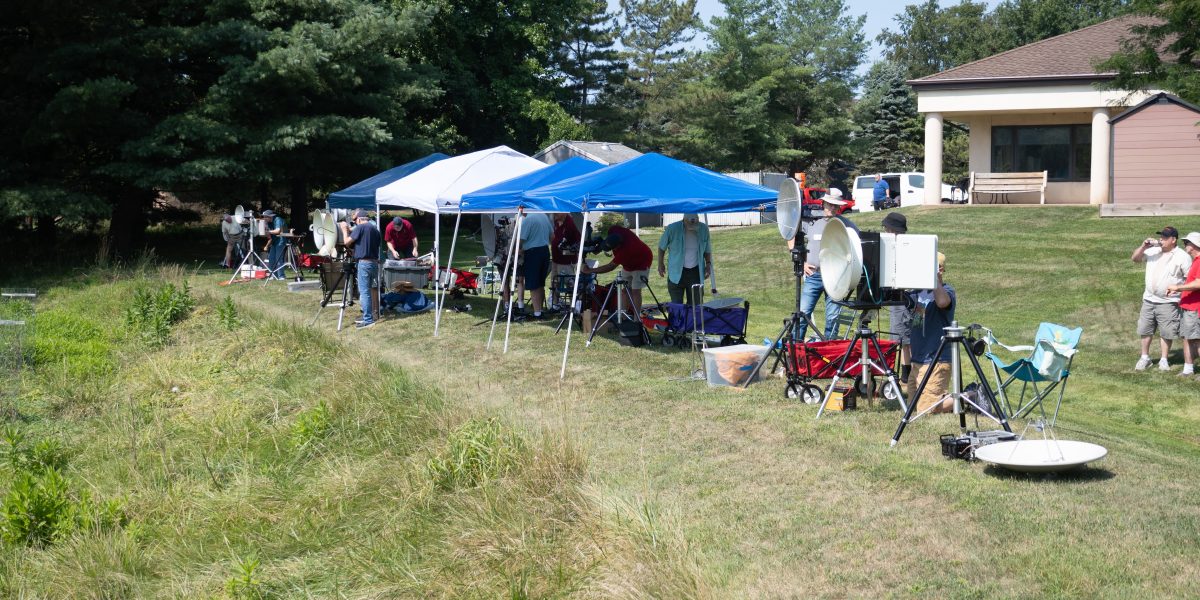
By the time the line was ready, it was a proper sight — canopies strung out along the hillside, one after another, each with a dish on a tripod and a folding chair behind it, all aimed downhill at a beacon most of us couldn’t see with the naked eye.
Walking the Line
Every station down that hill had its own story, and half the fun of being a spectator was walking it and hearing them.
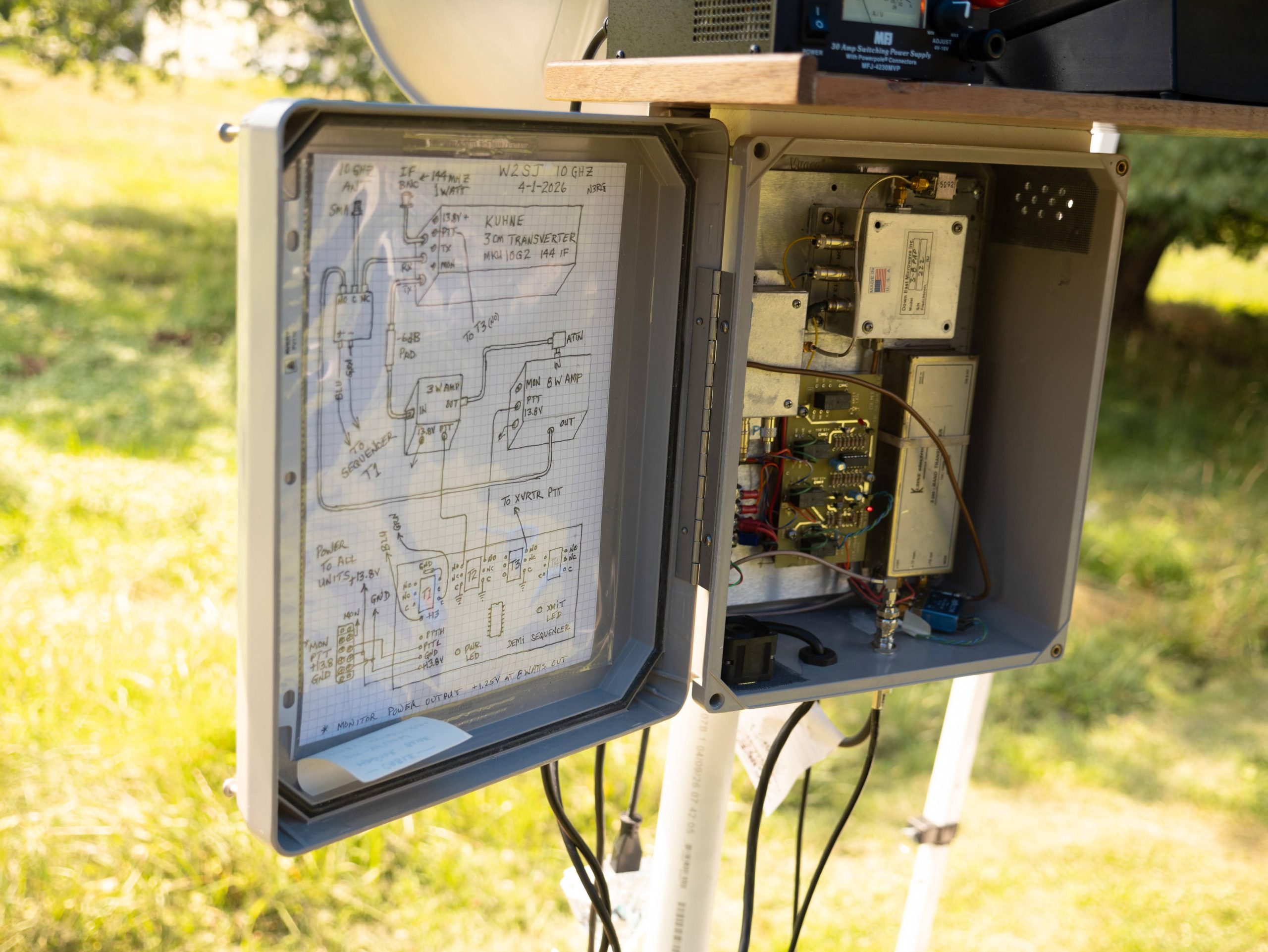
Bob, W2SJ, was running a 10 GHz rig built around a custom enclosure that Ray, N3RG, designed and built — and Ray hadn’t just built it, he’d documented it. Taped inside the lid was a hand-drawn schematic, dated and signed, laying out the whole signal path: a Kuhne MKU 10G2 transverter working a 144 MHz IF, a 3-watt driver feeding an 8-watt amplifier, a DEMI sequencer keeping the relays and PTT timing honest, and a Down East Microwave relay box handling the switching. It’s the kind of box that looks like overkill until you remember that at 10 GHz, sequencing and switching mistakes don’t just cost you a contact — they cost you a front end.
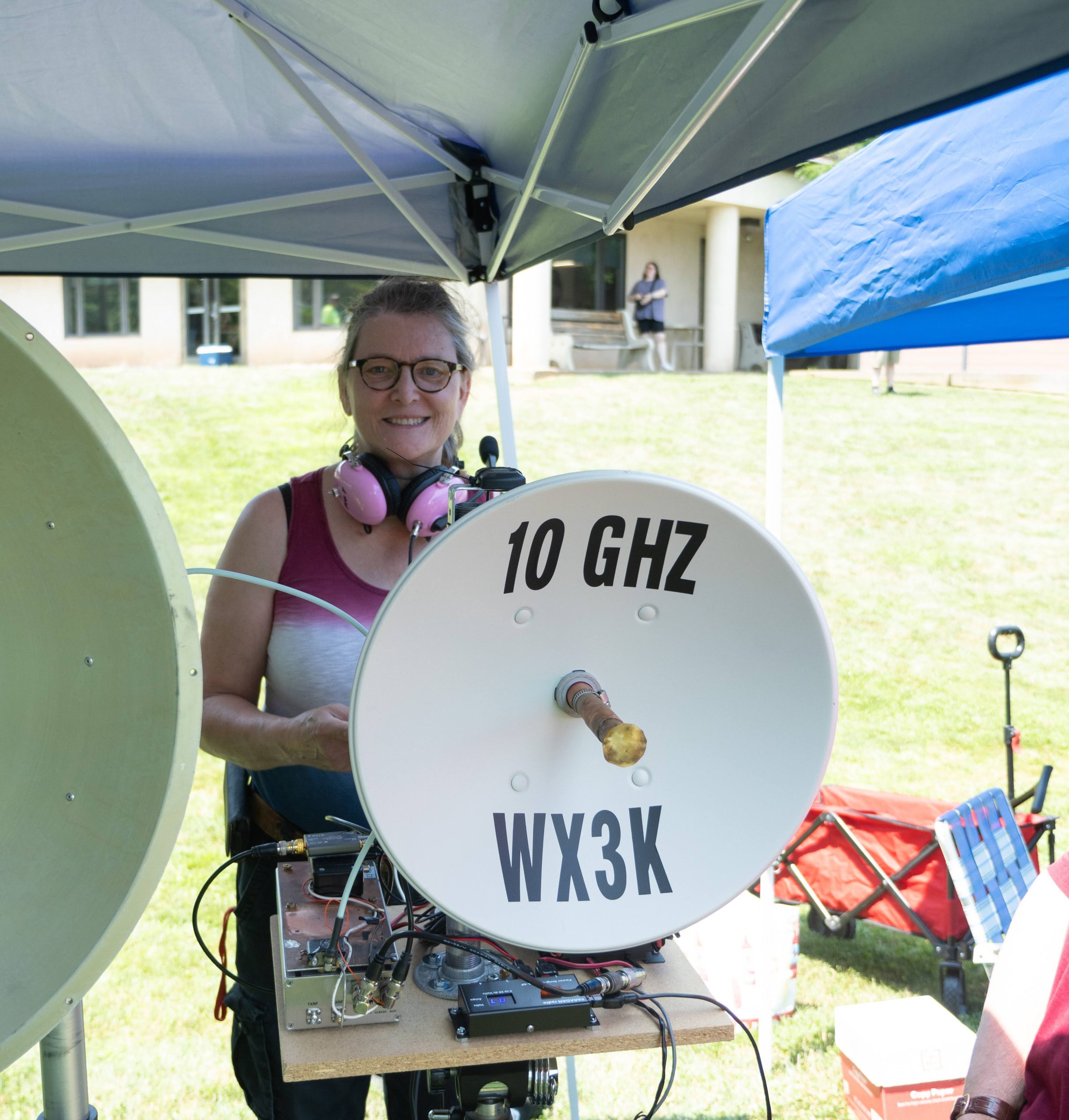
A few stations down, Stephanie, WX3K, had her own 10 GHz setup dialed in — dish clearly labeled, home-brew plate underneath carrying the preamp and PA. She was working the line with the same seriousness as everyone else, which is exactly how it should be. Weak-signal work doesn’t care how long you’ve been licensed.
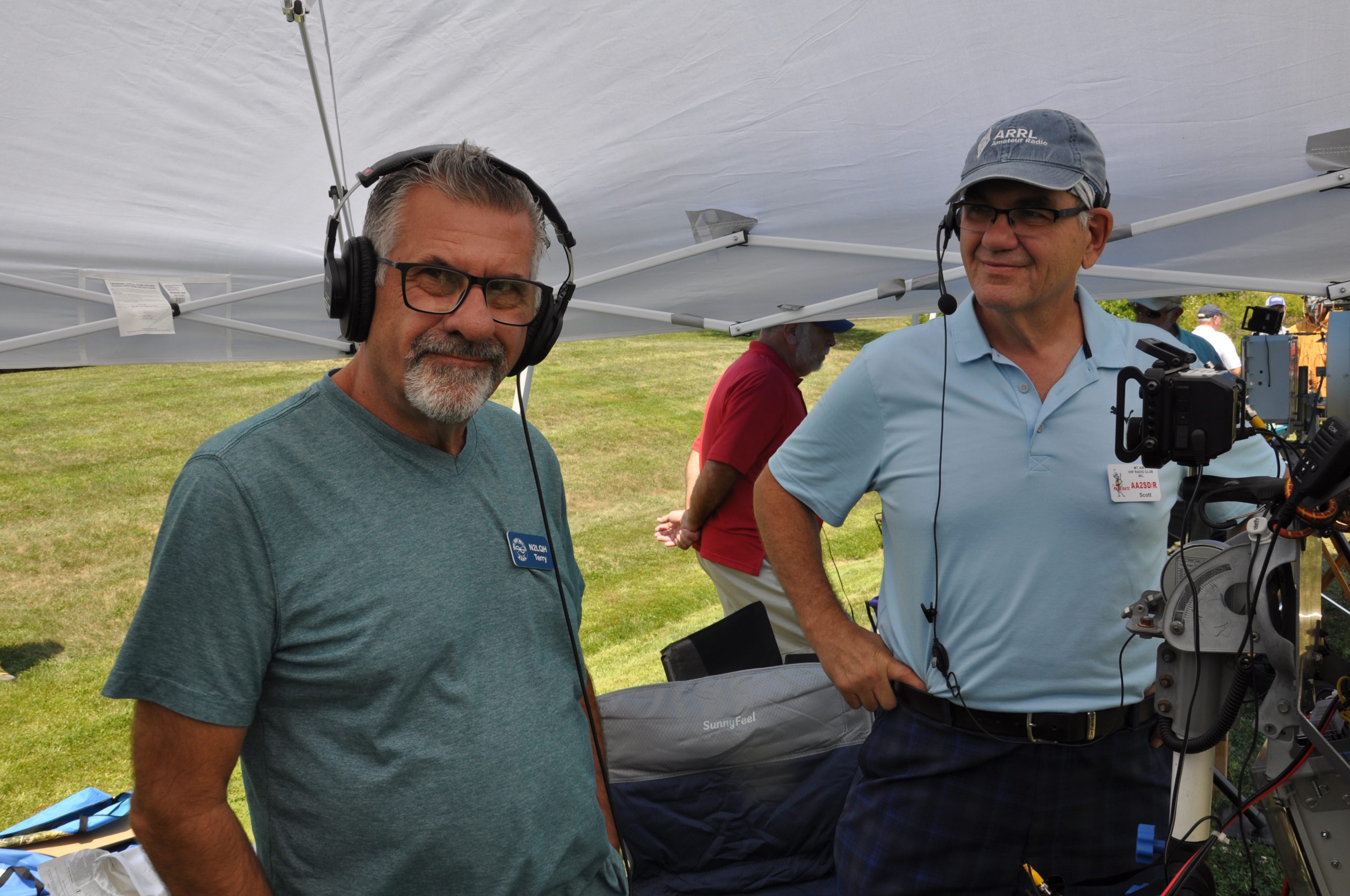
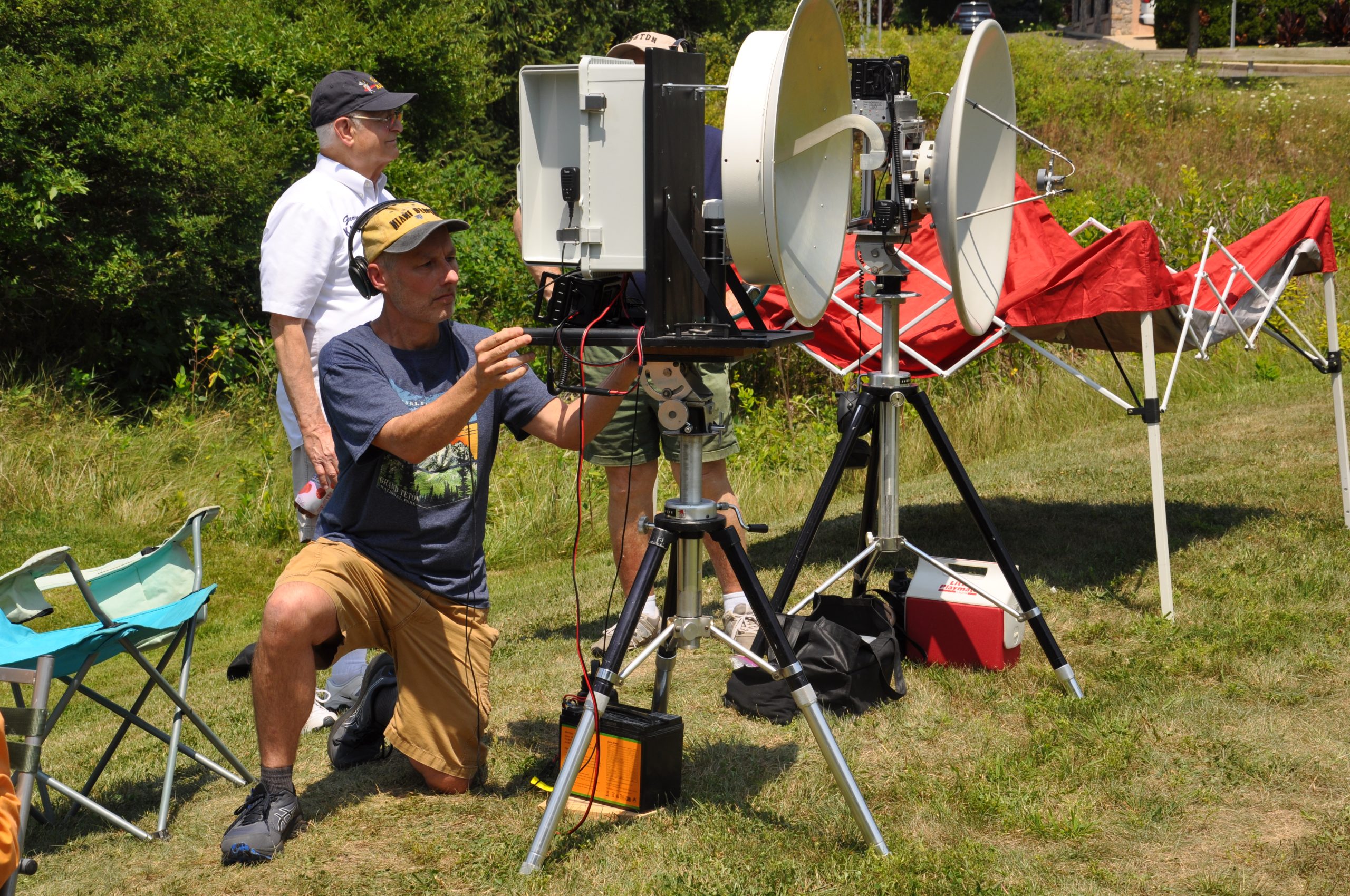
And then there was Scott, AA2SD, who showed up with two separate 10 GHz stations — a dish, and a horn antenna he calls “the shoebox,” because that’s more or less exactly what it looks like. Scott let me put his headphones on and actually work the shoebox through a round of MDS myself, which is the point where this stopped being spectating and started being personal. I did better than I expected — I pulled the beacon down to -68 dBm before it finally disappeared into the noise for good. I remember exactly how it felt: leaning in, dead still, willing a signal to be there that by all rights shouldn’t have been anymore.
What It Actually Sounds Like
If you’ve never listened to an MDS round, here’s the part nobody tells you: it’s not exciting in any conventional sense. It’s headphones and stillness and everybody leaning in a little closer to their radio as the beacon operator calls out the next step down. A few decibels in, people start dropping out — not because their gear failed, but because the signal genuinely isn’t there for them anymore. The ones still nodding along a round or two later aren’t hearing something magic. They’ve just built (or bought, or begged, borrowed, and modified) a front end good enough to make the most of every last dB they’ve got.
That’s the part that got me. It’s not really a contest about who can talk the loudest. It’s a contest about who can hear the quietest — and that comes down to noise figure, patience, and a whole lot of careful bench work long before anyone ever points a dish downhill. Andy, KF3Y — sworn in as a new Pack Rat right alongside me at the June meeting — ended up as one of the overall winners for the day, and watching him work his station mid-round, there was no wasted motion anywhere. Newest member or not, he’d clearly done this enough times to trust his gear completely.
Where This Leaves Me
I showed up with no 10 GHz gear and no immediate plans to get any. I’m leaving with a list.
Helping Dave trim in his dishes, walking Bob and Ray’s enclosure, watching Stephanie and Andy work their stations round after round — that all built the case. But the shoebox is what closed it. There’s a difference between watching someone chase a signal into the noise and doing it yourself with someone else’s headphones clamped on, and once I’d felt that difference, the decision more or less made itself. I’ve got the satellite build going and the rotator project wrapped up — 10 GHz on the weak-signal microwave side is next. There’s always another band worth losing sleep over.
Consider this the first entry in that series. There will be more.
73 de N2LQH · Terry Rossi · South Jersey