The Backyard Test Drive
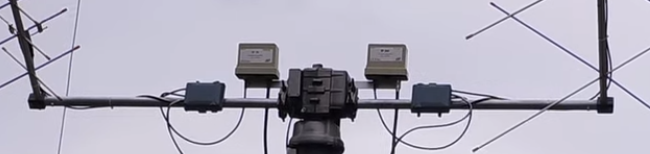
I drove out to Chris KC2IEB’s place, not entirely sure what I would find. He listed what i thought was a great satellite system for sale in one my clubs email reflectors. We’d talked through the gear — a complete amateur satellite station, antennas, preamps, rotator, controller and tripod — but there’s a difference between talking about a station and standing in somebody’s backyard while they actually spin the antennas up and show you it works. Chris did exactly that. We ran it through its paces right there behind his house, everything tracking the way it should, and by the time we were done I was already planning how it was all going to fit in the truck for the ride back to Tabernacle.
Chris took care of it because he cared about it. That came through in how he walked me through each piece, and — honestly — in the fact that he bothered to test it before he sold it. That’s a ham thing. You don’t hand off gear to somebody and hope for the best.
I’d been down the rabbit hole for weeks before I pulled the trigger. That’s how it goes with this hobby — one video leads to another, one article leads to a forum post, and before you know it you’re reading AMSAT’s Getting Started With Amateur Satellites guide at midnight thinking, how hard could this actually be?
Turns out: not as hard as you’d think. And also: a little harder than you’d think.
· · ·
Let me back up and explain what I bought, because this is a serious kit.
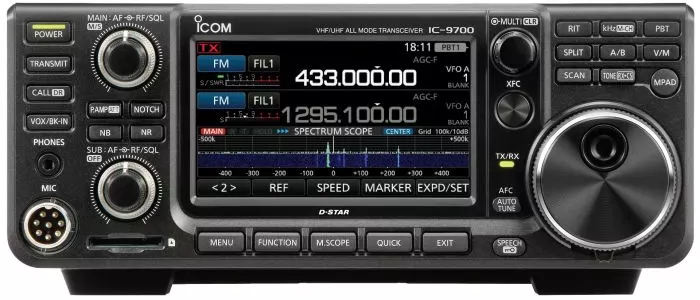
The ICOM IC-9700 is the heart of the system. It is the gold standard for working satellites. 2m/70cm and 1296 are the bands you need to work the birds. It is also full duplex, meaning you can transmit on one band and receive on another band at the same time.
The centerpiece of the antenna system is the M2 LEO-Pack – a matched set sold by DX Engineering and others. Made by M2 Antenna Systems out of Fresno, California, and probably the most popular turnkey antenna solution in the amateur satellite world for good reason. The LEO-Pack combines two purpose-built circularly polarized Yagis on a single custom M2 cross boom: the 2MCP8A for 2 meters (144 MHz) and the 436CP16 for 70 centimeters (435 MHz). Eight elements on the 2-meter side, sixteen on the 70-centimeter side, both optimized specifically for Low Earth Orbit satellite work.
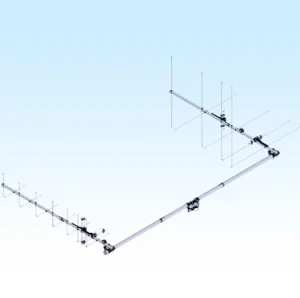
Circular polarization matters here in a way it doesn’t on terrestrial links. As a satellite tumbles through its orbit, its signal rotates. A linearly polarized antenna — the kind most of us think of first — would lose anywhere from 3 to 20-some dB every time the polarization plane crossed the wrong angle to your antenna. A circularly polarized antenna just receives it all. The M2 antennas achieve this through a phasing harness that combines horizontal and vertical elements in quadrature, creating a continuous rotating field. The whole thing is CNC machined, O-ring sealed, and built to live on a mast through South Jersey winters without complaint.
The custom M2 cross boom is what makes the LEO-Pack more than just two antennas — it keeps both beams co-aligned so they track together as a single unit. Which brings us to what drives them.
· · ·
Pointing antennas at a satellite crossing the sky at 17,500 miles per hour requires a different approach than pointing at a fixed tower. You need a dual-axis rotator — azimuth and elevation — that can be told where to point and actually get there fast enough to matter.
On this station, that job falls to a Yaesu G-5500DC, the DC-powered version of the G-5500 — the workhorse of the amateur satellite community for decades. It runs two separate motors, one for each axis, and it integrates cleanly with computer tracking software for automatic satellite following.
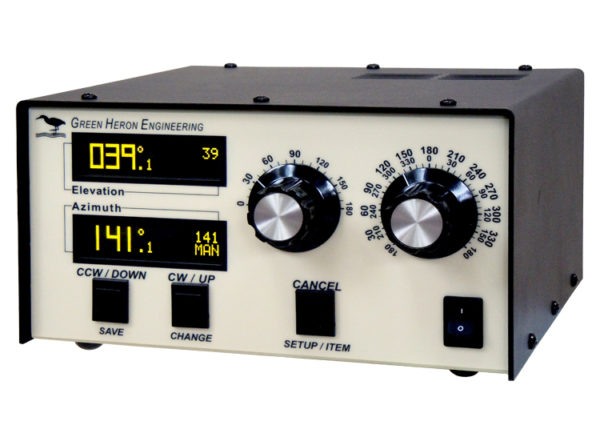
Controlling it is a Green Heron RT-21 AZ/EL — a dual-axis rotator controller from Green Heron Engineering up in New York state that the contesting and satellite communities have been trusting for years. The controller has two RT-21’s built into one enclosure. It handles both the azimuth and elevation axes in one compact box, talks to the computer over USB, and drives the Yaesu motors with the kind of precision you actually need when you’re tracking a moving target to tenths of a degree. The combo of the G-5500DC and the Green Heron controller is, as one AMSAT forum post I came across put it, “a popular combo” — which is ham-speak for it works and people don’t have to complain about it.
That pairing matters a lot. Satellite passes aren’t long — you might get eight minutes, maybe twelve on a good high pass — and you can’t spend them fighting your rotator.
· · ·
The preamps are where it gets interesting — and where this story takes its first detour.
Mounted at the antenna, as close to each feedpoint as possible, are a pair of SSB Electronics mast-mounted preamplifiers. The SP 200 handles 2 meters; the SP 70 handles 70 centimeters. Both are what the satellite world calls mast-mounted, RF-sensed preamps — meaning they live at the antenna, not in The Lab, and they automatically switch between transmit and receive by detecting the RF from your radio when you key up.
That placement is everything. Every foot of coax between your antenna and your preamp adds noise to a signal you’re already barely hearing. A satellite four hundred miles overhead running a few watts into an omnidirectional antenna is not a loud signal by any definition. You want the preamp as close to the feedpoint as physics will allow. The SP 200 brings the 2-meter system noise figure down to around 0.5 dB. The SP 70 pulls the 70 cm side to about 1.0 dB. Those numbers sound small until you understand what they mean in practice — the difference between copying a weak downlink and watching the squelch just sit there doing nothing.
Both units feed down the mast through two runs of Times Microwave LMR-400 — 100 feet each — the serious coax you use when you’ve decided to stop leaving signal in the feedline. 100 feet might be two long for my use but we’ll see when we get the tower placed. About $380 worth, plus interconnects for the filters. And yes, there are bandpass filters in the chain — tight on 144–146 MHz for 2 meters and 430–450 MHz for 70 centimeters — keeping the receiver from seeing everything it shouldn’t.
· · ·
Chris has discovered a problem.
One of the preamps — the SP 200, the 2-meter unit — had clearly seen some water at some point in its life. Not catastrophic damage. Nothing corroded beyond recovery. But inside the housing, there was evidence of water intrusion, and the MMIC — the Monolithic Microwave Integrated Circuit at the heart of the amplifier, the tiny chip that does the actual amplification work — was compromised. An ERA-6SM+, made by Mini-Circuits. A component about the size of a grain of rice that retails for a few dollars and does about a thousand dollars worth of work when it’s happy and sitting in the right circuit.
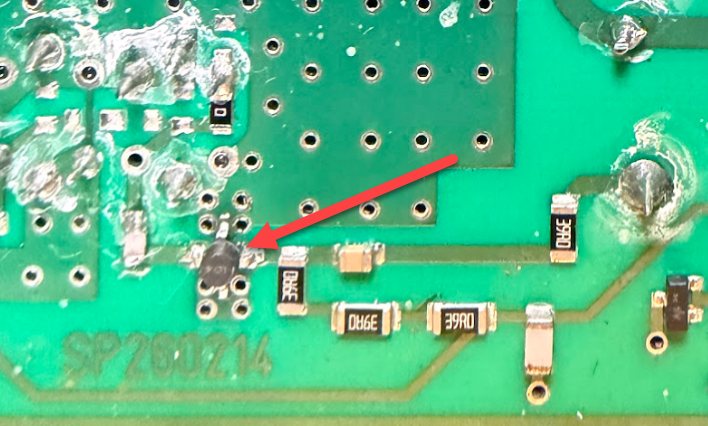
This is where Ray N3RG enters the story.
Ray is a seasoned RF engineer, long-term HAM, and a great elmer – always willing to help anyone. He took one look at the situation and knew exactly what needed to happen: replace the MMIC. Reflow solder on a microwave substrate PCB. Swap a surface-mount component using a hot air station. Measure before and after with a spectrum analyzer to confirm the gain is back where it should be. The kind of repair that would have sent most people straight to DX Engineering for a replacement unit. Ray just rolled up his sleeves and started diagnosing without a schematic.
There’s something about the ham community I keep rediscovering every time I’m back in it. Somebody always knows how to fix the thing. Somebody always shows up.
We’ll document the full repair — with photos of the board, the hot air work, the before-and-after measurements — in a follow-up post. The SP 200 will come out of this better than new.
· · ·
So where does this leave me?
The M2 LEO-Pack is waiting for a tower. The G-5500DC and Green Heron controllers are awaiting mounting and cabling. The SP 70 is healthy and ready to go. The SP 200 is in surgery with Ray. There’s 200 feet of LMR-400, a pair of bandpass filters, and the AMSAT guide dog-eared to Chapter Four sitting on the bench in The Lab.
What comes next is a staged build: get it in the air first, then integrate the S.A.T. controller for automated satellite tracking, tie it into Ham Radio Deluxe for logging, and eventually put the whole system on the air for a first real contact.
This post is the first in what will be an ongoing series. I’ll be updating it as each stage comes together — the mechanical installation, the preamp repair, the software integration, the first pass, the first QSO. Every step will get documented here as it happens.
I’m building a ground station to talk to things in space. In the backyard. In Tabernacle, New Jersey.
The hobby never gets old.
This article will be updated periodically as the satellite station comes online — preamp repair, S.A.T. controller integration, Ham Radio Deluxe connection, and first QSOs. Check back.
73 de N2LQH · Terry Rossi · South Jersey